Parshat Bereishit: The Human Story
How does beginning with one human being create peace? The Talmud responds: so that no one should ever be able to say to another person, “My father is greater than your father.”
This week, we begin the cycle of Torah readings anew, starting at the beginning, naturally, with Parshat Bereishit — the opening chapters of Genesis.
We are introduced to the enigmatic origins of reality and existence as we know it, as well as Adam haRishon — literally, the first human. Chava (Eve), Adam’s mate, would soon be formed “from Adam” as well. But our tradition teaches that initially, both masculine and feminine qualities — and indeed, all possible human qualities — were encapsulated within one singular human being: Adam.
Rashi, the famed medieval French commentator on the Torah, notices a seeming discrepancy in the story of humanity’s creation. First, the Torah says, “In the image of God, God created him” — singular. But in the very same verse, it continues, “Male and female, God created them” — plural.
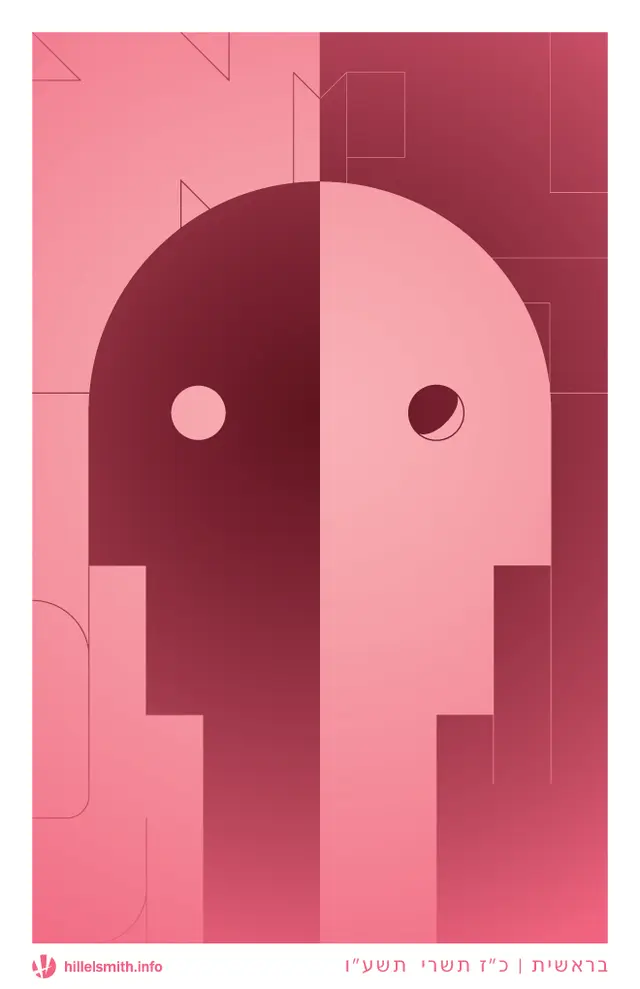
To make sense of this, Rashi draws upon a midrash — an ancient rabbinic interpretation of the biblical text. The midrash imagines that the first human was created with “two faces,” containing within one being what would later become Adam and Chava. Only afterward was this first human “divided” into two.
Humanity, in other words, begins as a singularity.
The Talmud approaches this idea from a slightly different angle. In asking why God created just one human being at the beginning — rather than an entire population — the rabbis answer that it was for the sake of shalom habriot: peace among all created beings, among all people.
How does beginning with one human being create peace?
The Talmud responds: so that no one should ever be able to say to another person, “My father is greater than your father.”
Ultimately, we all come from the same ancestor. So how can there truly be a better people — a better nation, a better tribe, a better race?
And if humanity was first imagined with masculine and feminine integrated within one human whole, how can one sex or gender claim to be inherently better, stronger, smarter, or more deserving than another?
We are not each other’s superiors and inferiors, the Torah insists. Rather, we are all children of the same human family, equally sharing in its gifts and its flaws.
When we encounter the many distinctions and divisions within that family, we would do well to remember that the Creator first formed us as one. It remains within our hands whether we choose to see ourselves and each other that way — or whether, God forbid, we travel down the illusory pathways of believing that our differences make some of us more human than others.
The story of Parshat Bereishit is therefore simultaneously an individual story, a family story, and the human story.
May we merit to see all three as one in our lives.
—
Welcome to Torah in Harlem! As we move through each week, we’ll explore the stories and insights of the weekly Torah portion—the ancient text at the heart of Jewish life—and let them inspire conversation in our community. Our hope is to cultivate a gathering place where learning belongs, reflection brings joy, and we can all grow together. Want to hop into the conversation? Join our Torah in Harlem Whatsapp Group.
Artwork by Hillel Smith.