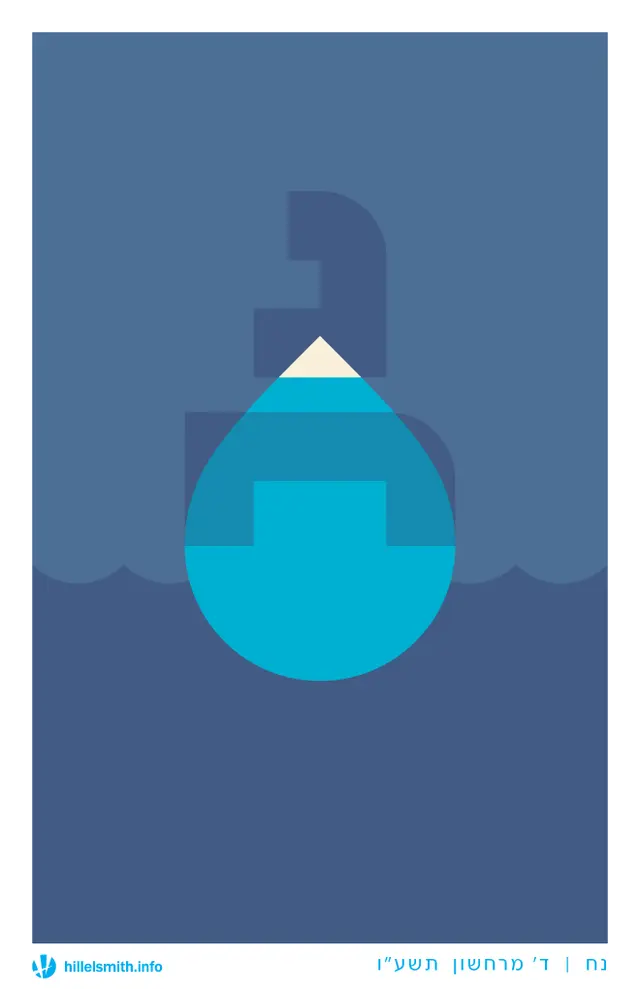
Parshat Ki Tisa: The Torah of the Day and Night
The rabbis pose a question about a moment many of us know well: Moses receiving the Torah atop Mount Sinai for "forty days and forty nights." If Moses was in such luminous closeness to God, the rabbis wonder, how could there have been night?
Welcome to Torah in Harlem! As we move through each week, we’ll explore the stories and insights of the weekly Torah portion—the ancient text at the heart of Jewish life—and let them inspire conversation in our community. Our hope is to cultivate a gathering place where learning belongs, reflection brings joy, and we can all grow together.
Artwork by Hillel Smith.
Someone who experienced the full range of human and spiritual extremes in our Torah is Moshe Rabbeinu—Moses, our teacher. At moments he stands closer to God than any human being in the Torah. And yet, even Moshe’s story contains darkness. In the Midrash Tanchuma on Parshat Ki Tisa, the rabbis pose a question about a moment many of us know well: Moshe receiving the Torah atop Mount Sinai for "forty days and forty nights." If Moshe was in such luminous closeness to God, the rabbis wonder, how could there possibly have been night?
The midrash then offers a striking answer. By day, Moshe learned the Written Torah. By night, he learned the Oral Torah. In other words, Moshe could tell whether it was day or night not by the sun, but by the kind of Torah he was learning. Daytime Torah was clear and structured: the text itself. Nighttime Torah was interpretive, searching, unfolding through conversation and questioning. Of course, Moshe could not literally have been learning Mishnah or Talmud, which were written long after his lifetime. The rabbis know that. The midrash is doing something else: using the language of “day and night” to describe different kinds of wisdom.
The midrash invites us to imagine that there are two kinds of Torah (literally: "instruction") available to us in life. There is the Torah of the day, characterized by clarity, guidance, and direction. It helps us decide what to do. And there is the Torah of the night, which is quieter, more searching, and sometimes lonelier. It helps us sit with questions that cannot be solved quickly. We can see both of these modes around us. There are people responding to the upheavals of life with Torah of the day, which asks: What action should we take? Should we attend a vigil, call our congressperson, or change our public behavior in visible ways? These questions are about concrete steps. But the Torah of the night asks something different: What do we do with our feelings themselves: fear, vulnerability, uncertainty, and our awareness of how finite life is? Night Torah does not rush toward answers. It invites us to sit with meaning.
And perhaps this is where the deeper lesson of the midrash emerges. The Torah of the night is rarely learned alone. It comes alive in conversation. In the kind of questioning and meaning-making that happens when people gather together. The Oral Torah itself is a communal project: generations of voices wrestling with life’s hardest moments side by side. Moshe may have stood alone on the mountain, but the Torah he received at night would only ever live through a people learning together. When life grows dark, the Torah we most need is not only found in books or in answers. It is found in community: in the sacred work of sitting together in the night and making meaning with one another.